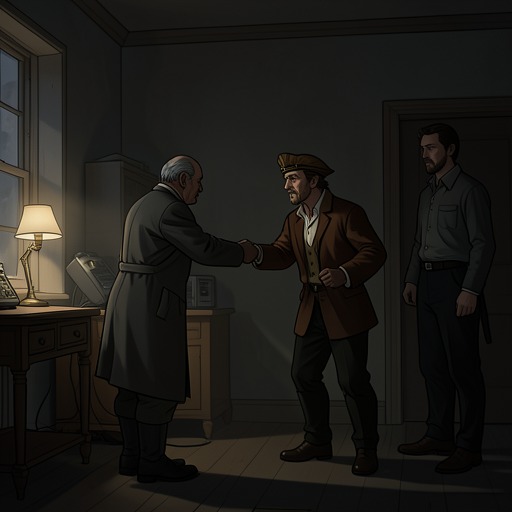
Bella Baxter—Duncan Wedderburn
Poor ThingsBella Baxter—Duncan Wedderburn is a volatile relationship in which the promise of a shared life repeatedly collides with Duncan’s compulsive gambling and Bella’s insistence on retaining her freedom. Their journey becomes a series of tests over money and trust: Bella hides funds to preserve a way forward, Duncan treats marriage as a claim on her, and even apparent reconciliation gives way to suspicion and another crisis. Their final separation is not a romantic reunion but Bella’s deliberate release of Duncan, backed by money and practical help that allow her to leave him behind.
A Marriage Tested by Money
During their wedding journey, Bella recognizes that Duncan’s first great casino win has not ended his gambling. He boasts that his success came through reason rather than luck and invokes their marriage as a reason she should trust him. Bella answers that being his wife does not take away her right to leave, and warns that another visit to the betting shop will cost him everything. Rather than simply argue, she proposes a wager of her own: she asks him to give her five hundred friedrichs d’or, promising to return it and marry him if he comes back richer, but to keep it available for their escape if he loses the rest.
Duncan responds to this arrangement as though it guarantees his happiness. He kisses Bella and weeps, convinced that he will have everything he wants. Bella weeps too, but from pity rather than shared confidence in his plan. The contrast establishes a pattern that persists through their relationship: Duncan reads her actions as assurances of a future together, while Bella treats money and marriage as practical matters that must not cancel her independence.
Bella values solitude as well as companionship. After Duncan leaves to gamble, she enjoys waking, bathing, dressing, and eating alone, and reflects that married life should include time apart so the couple does not grow stale. Her wish for distance is not simply a rejection of intimacy; it is a condition she wants intimacy to accommodate. Duncan, by contrast, invests the relationship with a more possessive expectation, and their different assumptions become increasingly difficult to reconcile.
Gambling, Secrecy, and Care
Bella has already concealed four hundred friedrichs d’or from Duncan’s winnings while he slept. When he returns penniless after another gambling session, she uses the five hundred she has kept to continue the journey. Duncan believes her money will enable them to travel on together, but once they reach the station he slips away for what he calls one last chance to recover his losses. He loses everything again. Bella responds by pretending to share his despair, then leaves him waiting while she obtains the money needed to move them onward.
Duncan later kneels in a streaming gutter to beg Bella for cigar money. She drops her tragic performance and helps him up, telling him that she can afford to give it to him. His response turns her practical care into an accusation: he claims she got money by selling herself to the Russian gambler who had tried to seduce her after Duncan’s earlier victory. Bella does not explain the hidden winnings or defend herself against the charge. Her refusal to answer leaves Duncan’s suspicion intact, while also showing how the couple’s financial dependence has poisoned their ability to trust one another.
A Russian acquaintance had offered Bella a different way to understand the problem. Their candid conversation ranged over freedom, the soul, Russian literature, and the circumstances that had made him a gambler. After hearing about Duncan, he advised Bella to take him on a Mediterranean cruise aboard a cargo ship with passenger accommodation, where there would be little opportunity or social stimulus for gambling and fewer passengers to gossip. Bella kisses him in gratitude. The suggestion treats Duncan’s gambling as something that might be contained by a change of surroundings; the later journey shows the limits of that hope.
The Journey and Its Repeated Reversals
On the cargo ship Cut-use-off, Bella tries to quiet the thoughts that have been troubling her since Alexandria. She turns repeatedly to sex with Duncan, continuing until he begs her to stop; the tactic temporarily silences her thoughts but sickens them both, and the thoughts return. Bella broods for days. Duncan misreads her distress as resentment over having been driven into prostitution in Germany. When she tells him that this did not happen and reveals that she had taken the money from his winnings while he slept, he cannot accept the explanation at first. He fixates on the money as his own, turns himself upside down in the bunk, and repeats his claim through the night. Their attempt to resume sex does not repair the breach.
The later passage from Gibraltar to Marseille offers another apparent renewal. On the passenger ship, Duncan drinks wine with meals and plays cards with men in the saloon while Bella goes to bed. After winning, he seems cheerful and tells her that games of skill, rather than games of chance, are his true calling. Bella begins to enjoy what he calls their second honeymoon, but she expects the winnings to disappear. They stop at a hotel recommended by one of the card players, and Duncan spends five days at a café, club, or card-school until he has lost everything. He then admits that he is once again at Bella’s mercy and needs her to pay the hotel.
Bella acts before the next crisis can pull her back into the same cycle. She packs essentials into a handbag, makes herself and Duncan presentable, and takes him to the station for an overnight train to Paris. Duncan tries to return to the hotel for his father’s dressing-case and its silver-mounted brushes. Bella refuses, judging that the valuable object can serve as payment for their room. Her decision puts the practical necessities of escape ahead of Duncan’s attachment to his possessions. She reaches Paris asleep upright on a third-class carriage bench, relieved to have left Marseille behind.
Separation in Paris
In Paris, Bella has a small room of her own and recalls earlier visits to the Louvre and the Tuileries Gardens with Godwin Baxter. She recounts how Professor Jean-Martin Charcot tried to hypnotize her before an audience at the Salpêtrière; Bella pretended the attempt had worked to spare him embarrassment, and he called her the sanest English woman he had examined. This settled Parisian setting contrasts with the disorder of her life with Duncan, though his presence soon returns as the subject of the story.
Duncan’s final grievance turns their financial conflict into a complete rejection of the relationship. He blames Bella for stealing the five hundred friedrichs d’or and destroying his supposed run of luck. He imagines the fortune he might have won and the houses, yacht, country estate, and heavenly reward that he believes the lost money would have brought. He now claims to hate her and says poverty has chained him to the woman he holds responsible for his ruin. Bella answers by cutting open the lining of her coat and producing five hundred pounds sterling in Clydesdale and North of Scotland banknotes, kept for the moment when he would need to leave her. She urges him to return to Glasgow and offers him the chance to be free of her.
The offer does not calm Duncan. He tries to swallow the notes and then attempts to throw himself from a window; when he cannot open it, he rushes toward the stairs head first. Millie Cronquebil, listening from the adjoining room, calls her staff, who restrain him and give him brandy. Getting him onto a train to Calais is difficult, but Bella does not abandon her decision. Although Millie wants her to keep most of the money, Bella says it belongs to Duncan and is his reward for the weddings they shared. She intends to earn her own living instead. The relationship ends with a stark reversal: Bella uses the money that once bound them to release Duncan, while choosing work and self-reliance over another attempt to make their marriage succeed.